Admin module
A REST API with keys you can revoke
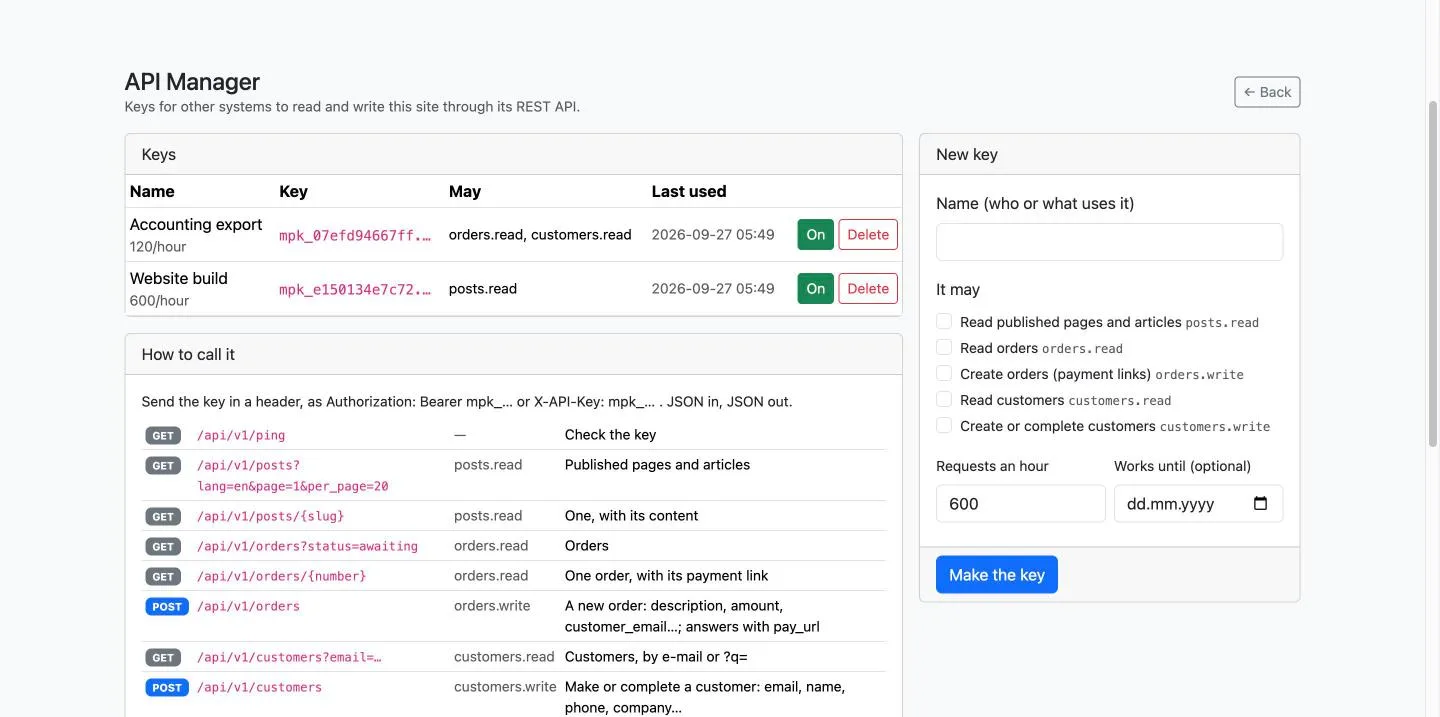
Admin → API Manager issues keys, decides what each one may do and writes down every request it makes. The API itself is six routes. This page is the whole of it.
Ask it something
Every call carries a key, in a header. There is no session, no cookie and no login form.
With a key
curl -H "Authorization: Bearer mpk_1a2b3c4d5e6f.…" \
     https://your-site/api/v1/posts

{
  "data": [ { "id": 12, "slug": "pricing", "lang": "en", … } ],
  "meta": { "count": 34 }
}
Without one
curl https://your-site/api/v1/ping

{
  "error": {
    "code": "unauthorized",
    "message": "A valid API key is needed:
      Authorization: Bearer mpk_… or X-API-Key."
  }
}
A key may do less than you can, never more
When you create a key you tick the scopes it needs. The panel then cuts that list down to what you are allowed to do: a key made by an editor cannot read orders, however many boxes were ticked.
A route with no scope for it answers 403 and says which scope it wanted. Nothing is guessed and nothing is implied.
The five scopes
posts.read— read published pages and articlesorders.read— read ordersorders.write— create orders, that is payment linkscustomers.read— read customerscustomers.write— create or complete customers
Six routes, and that is the list
GET   /api/v1/ping                 no scope, tells you the key works
GET   /api/v1/posts                posts.read
GET   /api/v1/orders               orders.read
POST  /api/v1/orders               orders.write   -> returns a payment link
GET   /api/v1/customers            customers.read
POST  /api/v1/customers            customers.write
Anything else answers 404 with a message telling you to look in the panel. The routes do not change when a module is switched on or off.
Shown once, stored as a hash
A key looks like mpk_1a2b3c4d5e6f.<40 hex>. The
part before the dot identifies it; the part after is the secret, and
the database keeps only a SHA-256 of it.
So the panel can show you a key exactly once, when it is made. After that nobody can read it back — not you, not an administrator, not somebody with a copy of the database. If it is lost, you make another and switch the old one off.
What a key carries
- A name, so you know what it is for
- Its scopes
- An hourly limit of its own
- An expiry date, if you set one
- An on/off switch that takes effect at once
Limits, and a log you can read
Each key has its own requests-per-hour figure, set when you make it. Wrong keys are counted separately, per address: fifty failures in an hour and that address is refused, so the key format cannot be guessed at leisure.
Every request is written down — the key, the method, the route and the status — and kept for 90 days, then deleted. When an integration starts misbehaving, the answer is in a table rather than in a guess.
The API Manager in action
The screenshot below shows the keys, the routes and the form for a new one. Clicking it opens a full size preview.