
Upload and order
Images go into a category and keep the order you put them in. Sorting is a number, not a drag you have to get right on a phone.
Admin module
A gallery is easy until it has to exist in two languages, keep its order, and have an address a customer can send to somebody. This is the screen where all three are decided.
The slug is shared — it is what the address is made of — and the title and description are a tab per language, exactly as an article is written. A gallery that runs in three languages has three titles and one address.
The lead image is chosen after the category has pictures in it, which is the only order that makes sense. Sort order decides the row, and a category can be deactivated without losing anything in it.
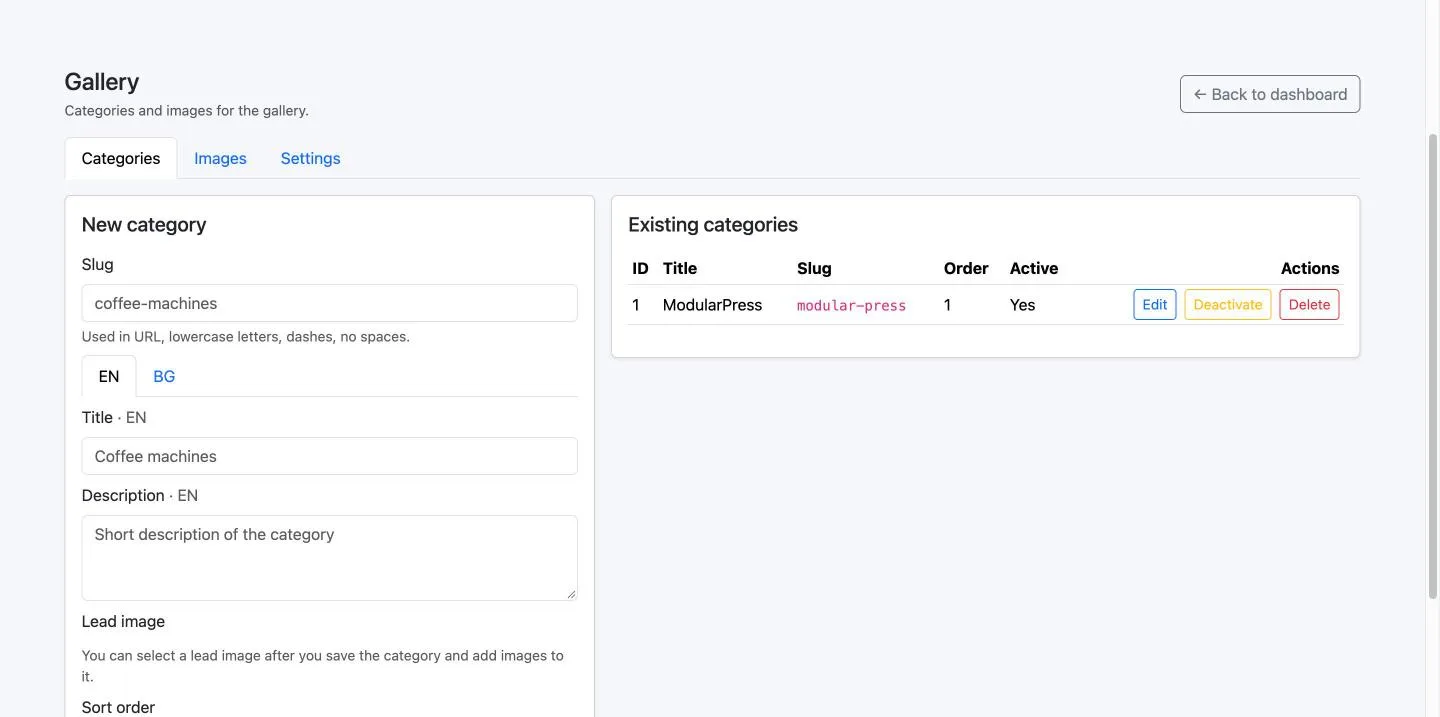
The parts that are boring to build and obvious when they are missing.
Images go into a category and keep the order you put them in. Sorting is a number, not a drag you have to get right on a phone.
Both the category and each image carry their text per language, in their own table, so a second language is data rather than a column somebody adds to the schema.
The public gallery is /gallery and
/gallery/{slug}, and each answers in whichever language
the visitor chose. Changing language leaves you on the same category.
How many per page and how the grid behaves, in the module rather than in the theme, so changing it is not a deploy.
Everything the site ships is written as AVIF and WebP beside the original, and the browser takes the smallest one it understands. Nothing is renamed and no markup changes: a browser that knows neither format reads the original exactly as before. It is how the home page went from 1.6 MB to 112 KB. See the gallery itself.