
Admin module
Taking money without running a shop
Most sites that sell something do not need a catalogue, a basket and a warehouse. They need one line, one price and a link that works. That is what an order is here.
Four steps, and then it is paid
The same four whether you typed the order yourself or a customer made it from a pricing page.
Write it
What is being sold, the amount and the currency, and the customer: name and e-mail, plus company, registration number, VAT number and address when there is an invoice to write.
Send the link
Every order gets an address of its own, /pay/ and
thirty-two hexadecimal characters. Nothing else identifies it, so
the link is the whole of the access and there is nothing to guess.
They pay
Card, PayPal or a bank transfer. The page prints the amount before anyone presses anything, and loads no third-party tracking.
It is marked paid
Never because a browser came back saying so. Only on a signature-verified callback, or a capture the payment provider confirms server to server.
The list is the whole state of the business
Number, customer, what it is for, the amount and the status, newest first. Search by number, customer, e-mail or description, and filter by status when you want to see only what is still owed.
An order is awaiting payment, paid or cancelled, and the status is read from the row rather than remembered anywhere else. The basket in the site header follows it: an order that has been paid or cancelled leaves the basket by itself.
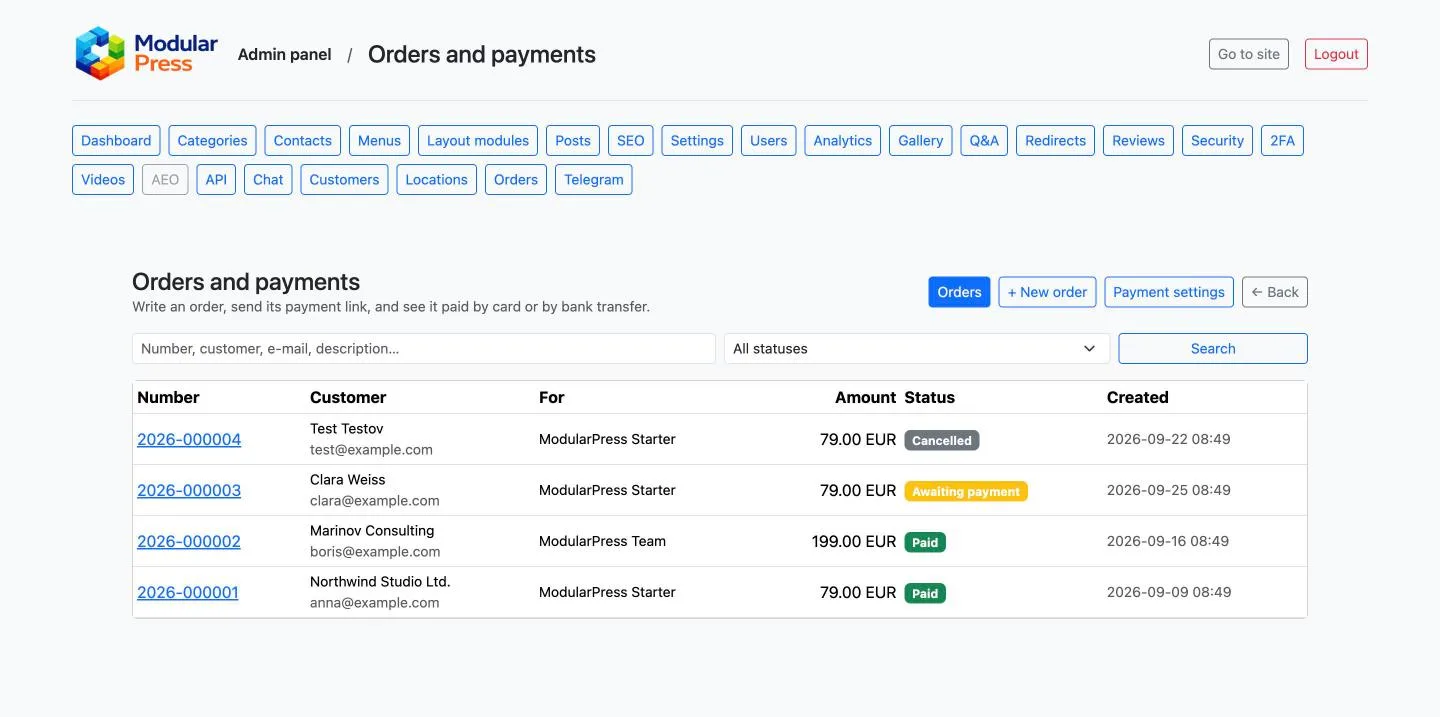
Three ways to be paid
Two of them are processors, and one of them is a human marking a line. All three end at the same door.
Card, through Borica
The Bulgarian virtual POS. Merchant and terminal ids and the RSA keys live in a file on the server and are never shown in the admin. Each click is its own attempt with its own reference, matched on the way back.
PayPal
A processor in its own right, for a site with no virtual POS behind it. The capture is confirmed server to server, on an amount and currency matching what the site asked for.
Bank transfer
The order shows the details, and somebody marks it paid when the money arrives. Unglamorous, and for a company invoice it is often the only thing the customer will do.
The rules that keep it honest
The amount charged is read from the order, never from the request, so a customer cannot decide their own price by editing a form. A payment is applied once, under a locked row, so the provider redelivering a notification changes nothing.
Test mode is the default and never marks a real order paid. A payment that arrives on a cancelled order is flagged as a conflict rather than quietly accepted, and a captured amount that does not match is written down for a human instead of being waved through.
Nothing about an order is revealed before the signature is verified: every refusal goes to a neutral result page, never to the order.
At a glance
- Link: /pay/ plus 32 hex characters
- Statuses: awaiting, paid, cancelled
- Providers: Borica, PayPal, bank transfer
- Applied: once, under a locked row
- Secrets: in a server file, not the database
And a customer can start one themselves
A plan page can create its own order: the visitor says who is buying, presses one button, and lands on the payment page. Pressing the button is a POST, so a crawler or a link preview cannot fill the table with orders nobody asked for. See the plans.