
Orders
Number, amount, currency and status, linking to the order itself. This is where a profile learns a company name, a registration number and an address.
Admin module
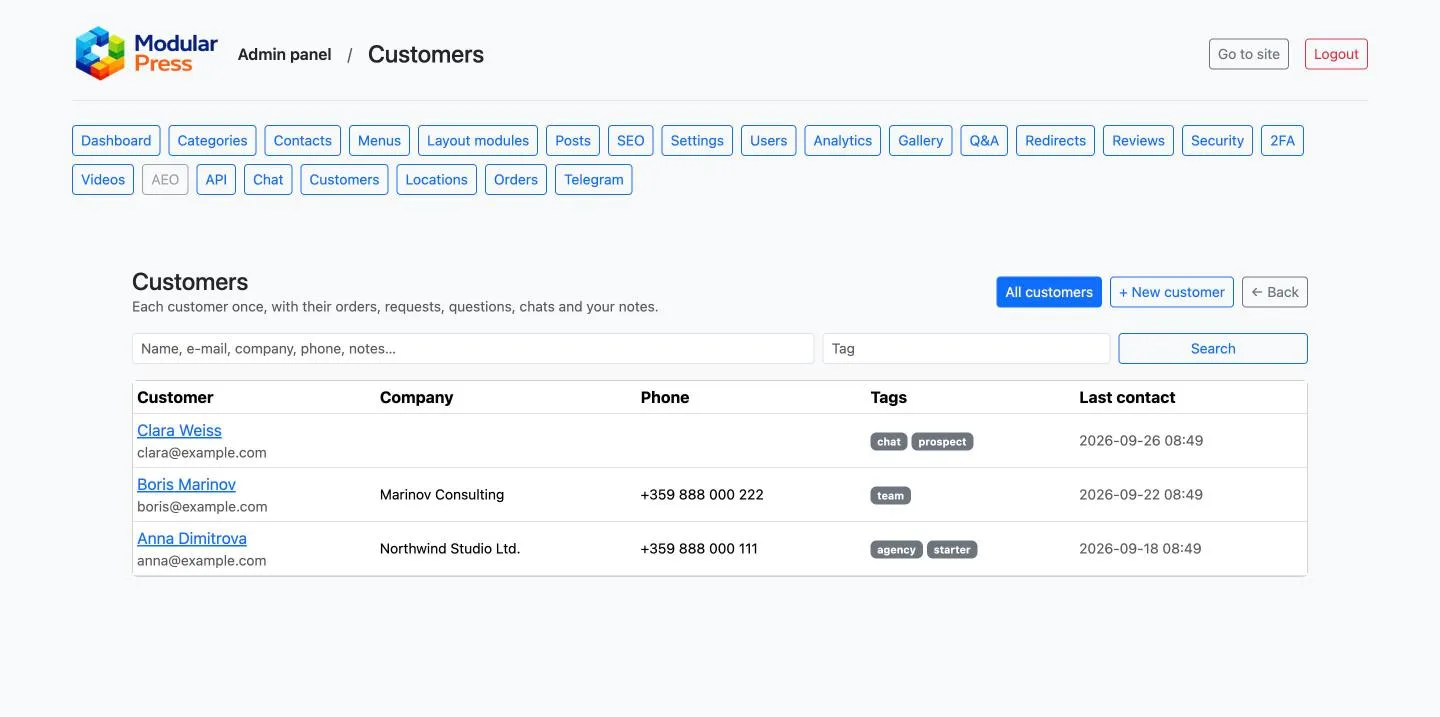
Somebody asks a question in March, opens a chat in June and buys in September. Without this they are three strangers. With it they are one customer, and the person answering can see what was already said.
Nobody types these in. An order, a question or a chat message hands over what it knows, and the module makes the profile or fills in the gaps in one that exists. The e-mail address is what ties them together.
It never overwrites what a person typed. If the team wrote the company name by hand, an order arriving later with a different one leaves it alone — a form is a guess, a colleague is not.
Tags are free text, so the vocabulary is yours: agency, team, prospect, whatever the business actually calls people.
Newest first, each one linking back to where it happened.
Number, amount, currency and status, linking to the order itself. This is where a profile learns a company name, a registration number and an address.
What they asked on the public Q&A page, and whether it has been answered yet.
Each conversation with its first message, so you can see what it was about without opening it.
A note, a call, an e-mail or a meeting, with who wrote it and when. The half a form can never collect.
Anyone can put anyone's e-mail into a chat box or a question form. The module knows this: an address that arrived that way is marked not verified on the timeline, and it never writes itself into an existing profile.
An order is different — somebody paid with it — so that one is trusted to complete a profile.
Each source is shown only to someone who may open that module. A colleague without access to orders sees the profile and the notes, and no orders at all — not a greyed-out row, nothing.
The customer modules are behind their own permissions for the same reason the public demo cannot read any of them.
When somebody asks to be erased, deleting the profile takes their notes and their chats with it, and strips the name and address off their questions while the words stay. Orders remain, because accounting law says they must — and that is the honest answer to give, rather than a promise the books will not keep.